
Navigating the world of e-commerce requires a keen understanding of profit margins – the lifeblood of any successful online business. Understanding how to calculate, analyze, and ultimately improve these margins is crucial for long-term sustainability and growth. This guide delves into the intricacies of e-commerce profitability, exploring various types of margins, influencing factors, cost structures, and strategies for optimization.
From defining gross, operating, and net profit margins to analyzing the impact of pricing strategies, marketing spend, and operational efficiency, we’ll equip you with the knowledge to assess your own e-commerce venture’s financial health. We’ll also explore best practices employed by thriving businesses and discuss the influence of external economic factors on profitability.
Defining E-commerce Profit Margins
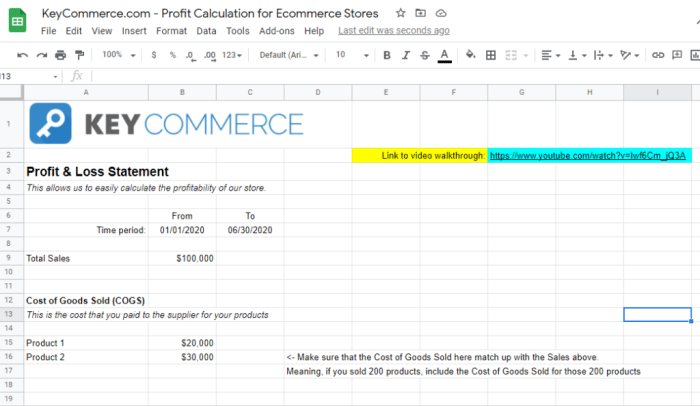
Understanding profit margins is crucial for the success of any e-commerce business. Profit margins represent the percentage of revenue remaining after deducting various costs. Analyzing these margins allows businesses to assess their pricing strategies, operational efficiency, and overall financial health. Different types of profit margins offer varying perspectives on profitability.
Types of E-commerce Profit Margins
E-commerce businesses utilize several key profit margin calculations to gauge their financial performance. These provide a comprehensive view of profitability at different stages of the business operation. The most common are gross profit margin, operating profit margin, and net profit margin.
Gross Profit Margin
Gross profit margin focuses on the profitability of a company’s products or services before considering operating expenses. It measures the percentage of revenue remaining after deducting the cost of goods sold (COGS). COGS includes direct costs associated with producing or acquiring the goods sold, such as raw materials, manufacturing, and direct labor for physical products, or licensing fees and content creation for digital products.
Gross Profit Margin = (Revenue – Cost of Goods Sold) / Revenue – 100%
For example, if an e-commerce store generates $100,000 in revenue and has a COGS of $60,000, its gross profit margin is ($100,000 – $60,000) / $100,000100% = 40%. This indicates that 40% of the revenue is available to cover operating expenses and generate profit.
Operating Profit Margin
Operating profit margin reflects the profitability of a business’s core operations after deducting both the cost of goods sold and operating expenses. Operating expenses include salaries, rent, marketing, and administrative costs.
Operating Profit Margin = (Revenue – Cost of Goods Sold – Operating Expenses) / Revenue – 100%
Using the previous example, if the e-commerce store has operating expenses of $20,000, its operating profit margin is ($100,000 – $60,000 – $20,000) / $100,000100% = 20%. This shows that 20% of the revenue remains after covering both COGS and operating expenses.
Net Profit Margin
Net profit margin represents the ultimate profitability of a business after all expenses, including taxes and interest, have been deducted. It shows the percentage of revenue that translates into actual profit.
Net Profit Margin = (Net Income) / Revenue – 100%
Continuing the example, if the e-commerce store has a net income of $15,000 after accounting for all expenses and taxes, its net profit margin is $15,000 / $100,000100% = 15%. This signifies that 15% of the revenue is the final profit.
Typical E-commerce Profit Margins Across Niches
The following table illustrates the typical profit margins across various e-commerce niches. These are averages and can vary significantly based on factors such as pricing strategies, competition, and operational efficiency.
| Niche | Gross Margin (%) | Operating Margin (%) | Net Margin (%) |
|---|---|---|---|
| Clothing & Apparel | 50-60 | 20-30 | 10-15 |
| Electronics | 25-35 | 10-15 | 5-10 |
| Health & Beauty | 55-65 | 25-35 | 12-18 |
| Books & Media | 30-40 | 15-20 | 7-12 |
Factors Influencing E-commerce Profit Margins
E-commerce profitability is a complex interplay of several key factors. Understanding these influences is crucial for businesses aiming to maximize their returns. While revenue generation is paramount, careful management of costs and operational efficiency are equally vital in achieving healthy profit margins. This section will delve into the specific factors that significantly impact the bottom line of online businesses.
Pricing Strategies and Their Impact on Profit Margins
Pricing strategies directly determine the revenue generated per sale, significantly influencing profit margins. A cost-plus pricing model, where a fixed markup is added to the cost of goods sold (COGS), offers simplicity but may not optimize profitability in competitive markets. Conversely, value-based pricing, which sets prices based on perceived customer value, can command higher margins but requires a strong understanding of customer needs and willingness to pay.
For example, a luxury goods e-commerce store might successfully employ value-based pricing, justifying higher prices through brand prestige and exclusivity, while a retailer selling everyday consumables might rely on a more competitive, cost-plus approach. The choice of pricing model hinges on factors such as market competition, brand positioning, and product differentiation.
Cost of Goods Sold (COGS) and Its Influence on Profitability
COGS represents the direct costs associated with producing or acquiring the goods sold. In e-commerce, this includes purchasing costs, import duties (if applicable), warehousing, and packaging. Minimizing COGS is a direct path to higher profit margins. Strategies such as negotiating favorable terms with suppliers, optimizing inventory management to reduce storage costs, and exploring alternative, more cost-effective packaging solutions can significantly impact the bottom line.
For instance, a business switching from expensive custom packaging to more economical, yet still attractive, generic options can lead to considerable savings.
Marketing Expenses and Their Relationship with Profitability
Marketing expenses, encompassing advertising, search engine optimization (), social media marketing, and email campaigns, are crucial for driving traffic and sales. However, uncontrolled marketing spend can severely erode profit margins. Effective marketing requires a strategic approach, focusing on high-return channels and carefully measuring the return on investment (ROI) of each campaign. A hypothetical scenario: Suppose an e-commerce business with a 10% profit margin spends 5% of its revenue on marketing.
If this marketing spend increases to 15% without a corresponding increase in sales, the profit margin will decrease to -5%. Conversely, if the increased marketing spend leads to a 20% increase in sales, the profit margin might rise to 12%. Careful analysis and optimization of marketing campaigns are essential for maximizing profitability.
Operational Efficiency and Its Contribution to Profit Margins
Operational efficiency encompasses all aspects of running the business smoothly and cost-effectively. This includes aspects like order fulfillment, customer service, and technology infrastructure. Streamlining processes, automating tasks, and investing in efficient technologies can significantly reduce operational costs and boost profit margins. For example, implementing an automated order fulfillment system can reduce labor costs and improve delivery times, contributing to improved customer satisfaction and reduced operational expenses.
Efficient warehouse management and robust customer service systems are equally crucial for a profitable e-commerce operation.
Economies of Scale and Their Impact on E-commerce Profitability
Economies of scale refer to the cost advantages that businesses gain as their production volume increases. In e-commerce, this can translate to lower per-unit costs for things like marketing, shipping, and customer service. As a business grows and processes more orders, it can negotiate better rates with suppliers, leverage bulk shipping discounts, and amortize the cost of its technology infrastructure over a larger customer base.
This allows for either increased profit margins or more competitive pricing, strengthening the business’s position in the market.
Analyzing Cost Structures in E-commerce
Understanding the cost structure of your e-commerce business is crucial for maximizing profit margins. A thorough analysis allows for informed decision-making regarding pricing, operational efficiency, and overall business strategy. Ignoring cost components can lead to inaccurate financial projections and ultimately, hinder profitability.
E-commerce Cost Components
E-commerce businesses face a unique set of costs compared to traditional brick-and-mortar stores. These costs can be broadly categorized into several key areas, each demanding careful consideration and management. Understanding these individual components allows for a more precise calculation of profitability and identification of areas for potential cost reduction.
- Website Hosting and Maintenance: This includes the costs associated with server space, domain name registration, website security, and ongoing maintenance and updates. Costs vary greatly depending on the platform (Shopify, Wix, custom-built) and traffic volume.
- Payment Processing Fees: These are charges levied by payment gateways (e.g., PayPal, Stripe) for processing transactions. Fees are typically a percentage of the transaction value plus a per-transaction fee. Negotiating lower rates with payment processors can significantly impact profitability.
- Shipping Costs: A major expense for most e-commerce businesses, shipping costs encompass packaging materials, postage, and potentially insurance. Factors influencing these costs include shipping method (e.g., standard, expedited), weight and dimensions of the product, and shipping distance. Strategies like offering free shipping above a certain order value can impact both costs and sales.
- Customer Service: Providing excellent customer service is essential for building brand loyalty and repeat business. Costs here include salaries or fees for customer service representatives, live chat software, email management tools, and handling returns/refunds.
- Marketing and Advertising: Attracting customers requires investment in marketing and advertising, encompassing activities like search engine optimization (), social media marketing, paid advertising (PPC), email marketing, and influencer collaborations. The effectiveness of these strategies greatly influences the return on investment (ROI).
- Inventory Management: Costs associated with storing and managing inventory, including warehouse space, inventory tracking software, and potential losses due to damaged or obsolete goods. Efficient inventory management is critical for minimizing storage and waste costs.
- Technology and Software: Beyond website hosting, businesses need various software tools for tasks like inventory management, order processing, customer relationship management (CRM), and accounting. Subscription fees for these tools contribute to operational costs.
Comparison of E-commerce Business Models
Different e-commerce business models have varying cost structures. Understanding these differences is key to choosing the right model and optimizing costs.
- Dropshipping: This model involves selling products without holding inventory. The supplier ships the product directly to the customer. Costs are relatively low upfront, primarily involving marketing and payment processing fees. However, profit margins can be lower due to reliance on external suppliers and less control over shipping and quality.
- Fulfillment by Amazon (FBA): Amazon handles storage, packaging, and shipping of products. This reduces operational overhead for the seller, but Amazon charges fees for these services. This model is beneficial for scalability and leveraging Amazon’s vast logistics network, but the fees can significantly impact profit margins, especially for low-priced items.
- Self-Fulfillment: The seller manages all aspects of fulfillment, including warehousing, packaging, and shipping. This offers greater control over the process but requires significant investment in infrastructure and personnel. Profit margins can be higher if managed efficiently, but it’s more labor-intensive and carries higher upfront costs.
Strategies for Reducing Operational Costs
Implementing cost-reduction strategies is vital for enhancing profit margins. A multifaceted approach focusing on several key areas can yield substantial improvements.
- Negotiate Better Rates with Suppliers and Vendors: Secure favorable pricing for products, shipping, and other services by negotiating contracts with multiple suppliers and leveraging bulk purchasing power.
- Optimize Shipping Strategies: Explore different shipping carriers and methods to find the most cost-effective options without compromising delivery times. Consider offering free shipping above a certain order value to incentivize larger orders and potentially offset increased shipping costs.
- Automate Processes: Implement automation tools for tasks like order processing, inventory management, and customer service to reduce labor costs and improve efficiency. This can involve integrating different software systems and utilizing automation features offered by e-commerce platforms.
- Improve Inventory Management: Utilize inventory management software to track stock levels accurately and minimize waste from overstocking or obsolete inventory. Implement strategies like just-in-time inventory management to reduce storage costs.
- Outsource Non-Core Functions: Consider outsourcing tasks like customer service, accounting, or marketing to specialized agencies if it proves more cost-effective than employing in-house staff.
- Invest in and Organic Marketing: Focus on improving organic search engine rankings to reduce reliance on costly paid advertising campaigns. This requires consistent effort in content creation and optimization.
Profit Margins
Understanding and optimizing profit margins is crucial for long-term success in the competitive e-commerce landscape. This section will explore benchmarking against industry averages, best practices for maintaining healthy margins, a step-by-step process for improving profitability, and the key characteristics of highly profitable e-commerce businesses.
Benchmarking E-commerce Profit Margins
Benchmarking involves comparing your e-commerce business’s profit margins to those of similar businesses within your industry. This provides a valuable context for evaluating your performance and identifying areas for improvement. Industry averages can be found through market research reports, industry associations, and financial databases. For example, a small online retailer selling handmade jewelry might benchmark against other Etsy sellers or small businesses in the craft industry, while a large online clothing retailer would compare itself to other major players in the apparel market.
Remember that these averages represent a range, and individual performance can vary significantly based on factors like business model, target market, and operational efficiency. Direct comparison to competitors should also consider their size and stage of growth.
Best Practices for Maintaining Healthy Profit Margins
Maintaining healthy profit margins requires a multi-faceted approach. Key strategies include optimizing pricing strategies to balance competitiveness and profitability, negotiating favorable terms with suppliers to reduce cost of goods sold, and implementing efficient inventory management techniques to minimize storage and waste. Furthermore, streamlining operations through automation, optimizing marketing spend for maximum return, and continually monitoring and analyzing key performance indicators (KPIs) are vital for sustained profitability.
For instance, a business might use A/B testing to optimize its advertising campaigns, ensuring that marketing investments generate a strong return. Similarly, implementing automated order fulfillment processes can significantly reduce labor costs and improve efficiency.
Analyzing and Improving E-commerce Profitability: A Step-by-Step Guide
A structured approach to analyzing and improving profitability is essential. This process can be broken down into several key steps:
- Calculate your current profit margin: Determine your gross profit margin (revenue – cost of goods sold) / revenue and net profit margin (net income / revenue). This establishes a baseline for comparison.
- Analyze your cost structure: Identify and categorize all your expenses (e.g., marketing, shipping, fulfillment, customer service). Determine which expenses are fixed and which are variable.
- Identify areas for cost reduction: Explore opportunities to reduce expenses without compromising quality or customer service. This could involve negotiating better rates with suppliers, optimizing shipping strategies, or automating tasks.
- Optimize pricing strategy: Evaluate your pricing model to ensure it’s aligned with your cost structure and market competitiveness. Consider value-based pricing, competitive pricing, or a hybrid approach.
- Increase sales volume: Explore strategies to increase sales, such as improving your website’s , running targeted marketing campaigns, and enhancing customer experience.
- Monitor and adjust: Regularly track your KPIs and make adjustments to your strategy as needed. This ensures that your efforts are consistently contributing to improved profitability.
Characteristics of High-Profit E-commerce Businesses
High-profit e-commerce businesses often share several key characteristics. They typically have a strong understanding of their target market and offer products or services that cater to specific needs and desires. They prioritize operational efficiency, often leveraging technology and automation to streamline processes and reduce costs. Furthermore, they focus on building strong customer relationships through exceptional customer service and personalized experiences, leading to increased customer loyalty and repeat purchases.
Finally, these businesses often employ data-driven decision-making, using analytics to inform their strategies and optimize their performance. For example, a business specializing in sustainable fashion might command premium prices due to its strong brand identity and commitment to ethical sourcing, leading to higher profit margins.
Impact of External Factors on Profit Margins
E-commerce businesses, while enjoying the advantages of online sales, are significantly influenced by external economic and market forces. These factors can dramatically impact pricing strategies, operational costs, and ultimately, profit margins. Understanding and adapting to these external pressures is crucial for long-term sustainability and success in the competitive e-commerce landscape.Economic conditions, particularly inflation and recession, exert considerable influence on e-commerce profitability.
Consumer spending habits shift dramatically during these periods, necessitating agile responses from businesses.
Economic Conditions and E-commerce Profitability
During inflationary periods, the rising cost of goods sold (COGS) directly impacts profit margins. Increased production costs, higher shipping fees, and escalating marketing expenses all contribute to a squeeze on profitability. Businesses may attempt to offset these increases by raising prices, but this carries the risk of reduced sales volume if consumers become price-sensitive. Conversely, recessions see a decline in consumer spending, forcing businesses to adopt more aggressive pricing strategies or risk unsold inventory.
For example, during the 2008 recession, many online retailers implemented deep discounts and promotional offers to stimulate demand and maintain some level of profitability, even if margins were temporarily compressed. This strategy requires careful balancing of sales volume against margin erosion.
Consumer Behavior and Pricing Strategies
Changes in consumer behavior directly influence pricing strategies and profitability. The rise of price comparison websites and the increased transparency of online pricing have empowered consumers to seek out the best deals. This necessitates competitive pricing and a focus on value-added services to differentiate from competitors. For instance, the growth of subscription boxes and personalized recommendations reflects a shift towards experiences and convenience, allowing businesses to justify premium pricing by offering enhanced value propositions.
Conversely, a sudden shift in consumer preference towards budget-friendly options would necessitate a review of pricing strategies to maintain market share, even if it means sacrificing some margin.
Competition and Market Saturation
The highly competitive nature of e-commerce, coupled with market saturation in certain sectors, exerts downward pressure on profit margins. The ease of entry into the e-commerce market means new competitors are constantly emerging, increasing competition for market share and potentially leading to price wars. This necessitates a focus on differentiation, building a strong brand identity, and offering superior customer service to stand out from the crowd.
For example, the highly competitive smartphone market demonstrates how intense competition can lead to razor-thin margins, requiring businesses to focus on high sales volume to achieve profitability. Market saturation can also lead to increased marketing expenses as businesses compete for visibility and customer attention, further impacting profit margins.
Mastering e-commerce profit margins is not merely about calculating numbers; it’s about strategically managing every aspect of your online business. By understanding the interplay between pricing, costs, and market dynamics, you can create a sustainable and profitable e-commerce enterprise. This guide provides a framework for continuous analysis and improvement, empowering you to make data-driven decisions that lead to enhanced profitability and long-term success.
Expert Answers
What is the difference between gross, operating, and net profit margin?
Gross profit margin reflects profit after deducting the cost of goods sold. Operating profit margin considers operating expenses. Net profit margin shows profit after all expenses, including taxes and interest.
How can I improve my e-commerce customer retention rate?
Implement loyalty programs, personalize customer experiences, provide excellent customer service, and actively solicit feedback to foster customer loyalty and repeat purchases.
What are some common pitfalls to avoid when setting e-commerce prices?
Avoid pricing too low (undercutting profits) or too high (deterring sales). Thoroughly research competitor pricing and consider your cost structure and value proposition.
How does seasonality impact e-commerce profit margins?
Seasonality can significantly influence sales and thus profit margins. Plan for peak and slow seasons by adjusting inventory, marketing spend, and pricing strategies accordingly.


