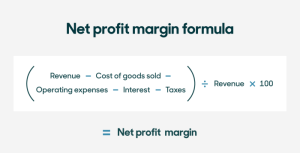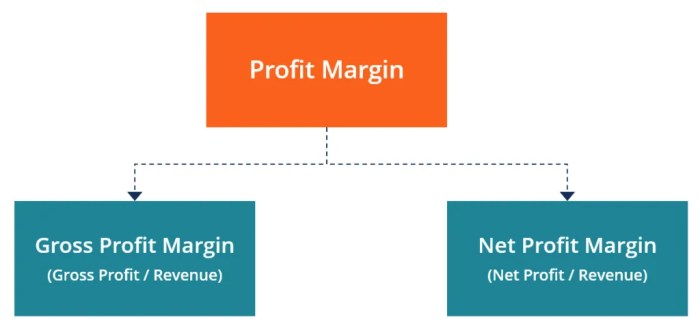
Profit margins, the lifeblood of any successful business, represent the difference between revenue and costs. Understanding and optimizing these margins is crucial for growth, sustainability, and attracting investment. This exploration delves into the various types of profit margins, their impact on business decisions, and strategies for improvement, providing a comprehensive overview of their significance in the modern business landscape.
From analyzing cost structures and pricing strategies to understanding the influence of external market forces, we’ll examine how businesses can effectively manage their profit margins to achieve long-term success. We’ll explore both the quantitative aspects of margin calculations and the qualitative factors that contribute to overall profitability.
Analyzing Profit Margins Over Time
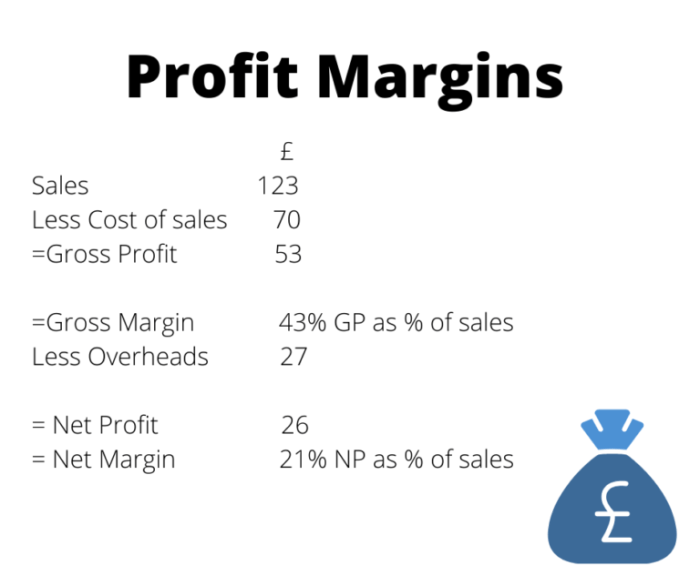
Analyzing profit margin trends over time is crucial for understanding a business’s financial health and identifying areas for improvement. By tracking these margins, businesses can gain valuable insights into the effectiveness of their pricing strategies, cost management, and overall operational efficiency. Consistent monitoring allows for proactive adjustments to maintain profitability and achieve long-term financial goals.Tracking profit margins over time reveals patterns and trends that might not be apparent from a single snapshot.
For example, a declining gross profit margin might indicate rising input costs, necessitating a review of supplier contracts or a search for more cost-effective materials. Similarly, a shrinking net profit margin might highlight the need for improved expense control or more efficient resource allocation. This historical data provides a valuable foundation for informed decision-making.
Profit Margin Trend Analysis Techniques
Analyzing profit margin trends typically involves comparing margins over several periods—monthly, quarterly, or annually—to identify consistent upward or downward movements. This can be visually represented using line graphs, making it easy to spot significant changes. For instance, a graph showing a consistent decline in gross profit margin over three years would immediately signal a need for investigation into the underlying causes.
Furthermore, statistical analysis, such as calculating moving averages or regression analysis, can help smooth out short-term fluctuations and reveal underlying trends more clearly. This allows for a more accurate assessment of long-term profitability.
Using Historical Data for Forecasting
Historical profit margin data serves as a valuable foundation for forecasting future performance. By analyzing past trends and considering external factors like inflation and market conditions, businesses can develop more accurate predictions. For example, a company with consistently growing profit margins over the past five years might project similar growth in the coming year, adjusting for anticipated inflation and potential changes in market demand.
However, it’s crucial to acknowledge limitations. Unforeseen events, such as economic downturns or unexpected competition, can significantly impact future performance. Therefore, forecasting should always incorporate a margin of error and sensitivity analysis to account for potential deviations from predicted trends. A simple example could be a company projecting a 5% increase in profit margin based on past performance, but also including a scenario planning model that considers a potential 2% decrease due to a predicted economic slowdown.
Benchmarking Against Competitors
Benchmarking profit margins against industry competitors provides valuable context for evaluating a company’s performance. By comparing margins to those of similar businesses, companies can identify areas where they excel or fall short. This requires accessing industry data from reliable sources such as market research firms or industry publications. For example, if a company’s net profit margin is significantly lower than the industry average, it suggests areas for improvement in cost control, pricing strategies, or operational efficiency.
This comparative analysis can highlight best practices and inform strategic decisions aimed at enhancing profitability and competitiveness. Consider a hypothetical scenario where Company A has a net profit margin of 8%, while the industry average is 12%. This disparity signals a need for Company A to analyze its operations and strategies to understand why its profitability lags behind its competitors.
Profit Margins and Industry Benchmarks
Understanding profit margins in relation to industry benchmarks is crucial for accurately assessing a company’s financial health and competitive positioning. By comparing a company’s performance to its peers, investors and managers can identify areas of strength and weakness, and inform strategic decision-making. This analysis provides a more nuanced perspective than simply examining a company’s absolute profit margin in isolation.Profit margins vary significantly across industries due to several factors including the nature of the product or service, the intensity of competition, the capital requirements, and the pricing power of companies within the industry.
Industries with High and Low Profit Margins
High profit margins are often found in industries with strong barriers to entry, high brand loyalty, or specialized products and services. The pharmaceutical industry, for example, typically boasts high profit margins due to the extensive research and development costs involved in bringing new drugs to market, coupled with patent protection which limits competition. Similarly, the software industry, particularly in niche segments, can also exhibit high margins due to the high value-added nature of software and the relatively low marginal cost of production and distribution once the software is developed.
In contrast, industries with low profit margins often experience intense competition, low switching costs for consumers, and high price sensitivity. The grocery industry, for instance, is characterized by thin margins due to the highly competitive nature of the market and the relatively low barriers to entry for new players. The airline industry also typically operates with low profit margins, affected by fluctuating fuel prices, intense competition, and high fixed costs.
Comparing Profit Margin Dynamics Across Sectors
Comparing profit margin dynamics across different sectors reveals interesting insights into industry structures and competitive landscapes. The technology sector, for example, has witnessed periods of both extremely high and relatively low profit margins, driven by rapid innovation, market consolidation, and shifts in consumer demand. In contrast, the utility sector often exhibits more stable, albeit lower, profit margins, due to regulated pricing structures and less volatile demand.
The financial services sector presents a mixed picture, with some segments like investment banking experiencing significant margin fluctuations while others, like insurance, display more consistent margins. Analyzing these variations helps understand the unique challenges and opportunities within each sector.
Using Industry Benchmarks for Financial Health Assessment
Industry benchmarks, often derived from publicly available financial data and industry reports, provide a crucial context for evaluating a company’s financial health. By comparing a company’s profit margin to the average or median margin of its competitors, investors and managers can quickly gauge its relative performance. For example, if a company in the software industry has a profit margin significantly below the industry average, it may indicate potential inefficiencies, pricing issues, or intense competitive pressure.
Conversely, a company exceeding the industry average might signal a strong competitive advantage, efficient operations, or effective pricing strategies. This benchmark analysis is not only valuable for identifying areas for improvement but also for supporting strategic decision-making, such as investment allocation or pricing adjustments.
Ultimately, the importance of profit margins cannot be overstated. They serve as a critical indicator of a company’s financial health, its ability to compete, and its potential for future growth. By diligently monitoring, analyzing, and strategically managing profit margins, businesses can navigate economic challenges, secure funding, and build a sustainable and thriving enterprise. A proactive approach to profit margin management is not just a financial imperative; it’s a cornerstone of long-term business success.
Expert Answers
What is the difference between gross, operating, and net profit margin?
Gross profit margin considers only the cost of goods sold. Operating profit margin includes operating expenses. Net profit margin accounts for all expenses, including taxes and interest.
How can I improve my profit margins quickly?
Short-term improvements can involve negotiating better deals with suppliers, increasing prices slightly (if market conditions allow), and streamlining operations to reduce waste.
What are some common mistakes businesses make with profit margins?
Common mistakes include underpricing products, neglecting cost control, failing to analyze market trends, and not regularly monitoring key performance indicators (KPIs).
How do profit margins relate to investor confidence?
High and stable profit margins signal financial strength and stability, attracting investors and making it easier to secure funding.