Understanding operating profit margin is crucial for any business, providing a clear picture of profitability from core operations. It’s not just a number on a financial statement; it’s a powerful indicator of efficiency, pricing strategies, and overall business health. This guide delves into the intricacies of calculating, analyzing, and interpreting operating profit margin, equipping you with the knowledge to make informed decisions and drive sustainable growth.
We’ll explore how various factors, from cost control to sales volume, influence this key metric. We’ll also compare it to other profitability ratios, providing a broader perspective on financial performance and demonstrating its value in benchmarking against competitors and forecasting future trends. By the end, you’ll have a solid grasp of how to leverage operating profit margin to enhance your business’s success.
Defining Operating Profit Margin
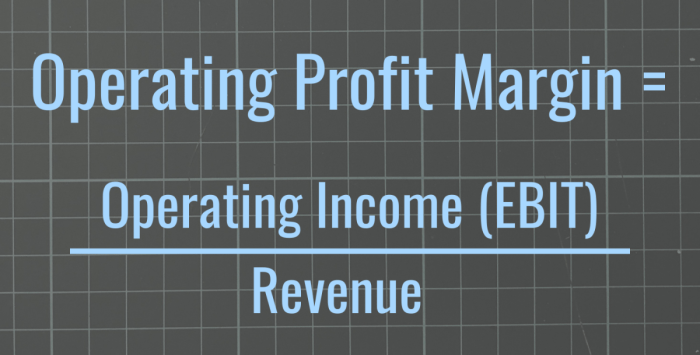
Operating profit margin is a crucial financial metric that reveals a company’s profitability from its core operations. It indicates how efficiently a business converts its revenue into profit, excluding factors like interest and taxes which can fluctuate significantly based on external factors and financing decisions. Understanding this metric provides valuable insights into a company’s operational efficiency and its ability to generate profits from its primary business activities.Operating profit margin is calculated by dividing operating profit by net revenue (or sales).
Operating profit represents the profit earned from a company’s main business activities, after deducting operating expenses. The formula is straightforward and widely used across various industries for comparative analysis.
Operating Profit Margin = (Operating Profit / Net Revenue) – 100%
Operating Profit Margin in Different Industries
The application and interpretation of operating profit margin vary significantly across industries. For instance, a high operating profit margin in the technology sector might indicate a strong brand and efficient product development, while a similar margin in the retail sector could point to effective cost management and pricing strategies. Conversely, a low margin in a highly competitive industry like grocery might be considered normal, reflecting the nature of the business and intense price competition.
The context of the industry is paramount in assessing the significance of a company’s operating profit margin. For example, a software company might have a higher operating profit margin than a supermarket chain due to differences in cost structures and business models. Comparing companies within the same industry offers a more meaningful comparison.
Comparison with Other Profitability Ratios
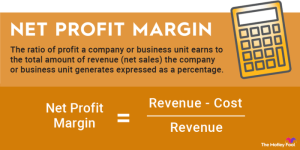
Operating profit margin is just one of several profitability ratios used to assess a company’s financial health. It differs from the gross profit margin, which only considers the cost of goods sold, and the net profit margin, which accounts for all expenses, including interest and taxes. Gross profit margin focuses solely on the profitability of production, while net profit margin provides a broader view of overall profitability.
Operating profit margin sits between these two, offering a more focused view of operational efficiency, excluding financing and tax effects. Analysts often use a combination of these ratios to gain a holistic understanding of a company’s financial performance.
Components of Operating Profit and Their Impact on Margin
The operating profit, the numerator in the operating profit margin calculation, is composed of several key components. Changes in any of these components directly impact the operating profit margin.
| Component | Formula | Example | Impact on Margin |
|---|---|---|---|
| Revenue | Sales of goods or services | $1,000,000 in sales | Higher revenue generally leads to a higher margin (assuming costs remain relatively constant). |
| Cost of Goods Sold (COGS) | Direct costs associated with producing goods or services | $400,000 in COGS | Lower COGS leads to a higher gross profit and, consequently, a higher operating profit margin. |
| Operating Expenses | Expenses incurred in running the business (e.g., salaries, rent, marketing) | $300,000 in operating expenses | Lower operating expenses directly increase operating profit and thus the margin. |
| Operating Profit | Revenue – COGS – Operating Expenses | $1,000,000 – $400,000 – $300,000 = $300,000 | The core element determining the operating profit margin. |
Analyzing Factors Influencing Operating Profit Margin
Understanding the factors that influence operating profit margin is crucial for businesses aiming for sustainable profitability. A higher operating profit margin indicates greater efficiency and profitability, while a lower margin suggests areas needing improvement. Analyzing these influences allows businesses to proactively adjust strategies and optimize their performance.
Key Factors Increasing Operating Profit Margin
Several key factors contribute to a higher operating profit margin. These factors often interrelate, creating a synergistic effect on profitability. For example, effective cost control measures can free up resources to invest in improved pricing strategies, leading to a more substantial increase in operating profit margin than either strategy alone. Conversely, neglecting cost control can quickly erode even the most successful pricing strategies.
Impact of Cost Control Strategies on Operating Profit Margin
Cost control strategies directly impact operating profit margin. By reducing costs without significantly impacting sales volume or product quality, a company can significantly improve its operating profit margin. Effective cost control encompasses various areas, including efficient inventory management (reducing storage costs and minimizing waste), streamlined production processes (improving efficiency and reducing material waste), and optimized supply chain management (negotiating better prices from suppliers and reducing transportation costs).
For instance, a manufacturing company that implements lean manufacturing principles might see a substantial reduction in production costs, directly boosting its operating profit margin.
Effects of Pricing Strategies on Operating Profit Margin
Pricing strategies play a crucial role in determining operating profit margin. While increasing prices can directly boost profit, it’s vital to consider market demand and competitor pricing. A well-defined pricing strategy considers factors like cost of goods sold, target market, competitive landscape, and perceived value. Premium pricing, for example, commands higher prices for high-quality products or services, resulting in a higher operating profit margin.
However, this approach requires a strong brand reputation and a unique selling proposition to justify the higher price point. Conversely, penetration pricing, which involves initially setting lower prices to gain market share, may lead to a lower operating profit margin in the short term but could pave the way for higher margins in the long run through increased sales volume.
Influence of Sales Volume and Operating Expenses on Operating Profit Margin
Sales volume and operating expenses are inversely related to operating profit margin. Increased sales volume, assuming costs remain relatively constant, leads to a higher operating profit margin. Conversely, higher operating expenses, such as increased rent, salaries, or marketing costs, reduce the operating profit margin, even if sales volume remains constant. The relationship can be expressed as:
Operating Profit Margin = (Revenue – Operating Expenses) / Revenue
A company with high sales volume but uncontrolled operating expenses might still have a lower operating profit margin than a company with lower sales volume but meticulously managed expenses. The optimal balance between sales volume and expense control is key to maximizing operating profit margin.
Internal and External Factors Affecting Operating Profit Margin
Understanding the various factors influencing operating profit margin requires considering both internal and external influences. These factors can significantly impact a company’s ability to control costs and generate revenue.
- Internal Factors: These factors are within the company’s control. Examples include production efficiency, marketing effectiveness, pricing strategies, inventory management, employee productivity, research and development investment, and overall operational efficiency.
- External Factors: These factors are largely outside the company’s direct control. Examples include economic conditions (recessions or booms), competition, government regulations (taxes, tariffs), changes in consumer preferences, and the availability of raw materials.
Interpreting Operating Profit Margin Trends
Understanding changes in a company’s operating profit margin over time provides valuable insights into its operational efficiency and profitability. Analyzing these trends, in conjunction with competitor data and market forecasts, allows for a more comprehensive assessment of the company’s financial health and future prospects. Consistent monitoring is crucial for effective strategic decision-making.Analyzing changes in operating profit margin requires a multifaceted approach.
Simply observing an increase or decrease isn’t sufficient; the underlying reasons must be investigated. For instance, a rising margin could be due to improved efficiency, increased pricing power, or reduced operating costs. Conversely, a declining margin might signal intensifying competition, rising input costs, or operational inefficiencies. A thorough analysis considers both internal factors (e.g., cost management, pricing strategies) and external factors (e.g., economic conditions, industry trends).
Benchmarking Against Competitors
Comparing a company’s operating profit margin to its competitors offers a valuable perspective on its relative performance within the industry. This benchmarking process helps identify areas of strength and weakness. For example, if Company A consistently maintains a higher operating profit margin than its main competitors (Company B and Company C), it suggests superior operational efficiency or a more effective pricing strategy.
Conversely, a lower margin might indicate a need for operational improvements or a reassessment of pricing strategies. This comparative analysis should consider industry-specific factors and the companies’ respective business models.
Forecasting Future Operating Profit Margin
Forecasting future operating profit margins involves analyzing historical data, projecting future sales, and estimating potential changes in operating costs. Simple linear regression models can be used to project future margins based on historical trends. However, these models should be augmented by considering external factors like anticipated changes in raw material prices, labor costs, and economic growth. More sophisticated forecasting techniques, such as time series analysis or econometric modeling, may be employed for greater accuracy.
For instance, a company expecting increased demand for its products might project a higher operating profit margin, assuming it can manage its costs effectively. Conversely, a company facing rising input costs might forecast a lower margin unless it can successfully implement cost-cutting measures or pass on increased costs to consumers.
Illustrative Timeline: Hypothetical Company “XYZ Corp”
Let’s consider a hypothetical company, XYZ Corp, operating in the technology sector. This timeline illustrates potential operating profit margin trends:
| Year | Operating Profit Margin (%) | Key Factors |
|---|---|---|
| 2020 | 10% | Market entry; high initial operating costs. |
| 2021 | 12% | Increased sales volume; economies of scale. |
| 2022 | 15% | Successful product launch; improved operational efficiency. |
| 2023 | 14% | Increased competition; rising raw material costs. |
| 2024 (Projected) | 16% | Successful cost-cutting measures; new market expansion. |
This hypothetical example demonstrates how operating profit margin can fluctuate due to various internal and external factors. Analyzing these factors allows for a more nuanced understanding of the underlying drivers of profitability. The projected margin for 2024 assumes successful implementation of cost-cutting strategies and expansion into new markets, which could positively impact profitability. However, unforeseen circumstances could influence the actual outcome.
Operating Profit Margin vs. Net Profit Margin
Both operating profit margin and net profit margin are crucial profitability ratios, but they offer different perspectives on a company’s financial health. Understanding their distinctions is vital for a comprehensive financial analysis. While both measure profitability, they do so by including different elements of a company’s income statement.Operating profit margin focuses solely on the profitability of a company’s core operations, excluding any gains or losses from peripheral activities.
Net profit margin, on the other hand, provides a more holistic picture by considering all income and expenses, including those outside the main business operations.
Calculation and Revelations of Each Metric
Operating profit margin is calculated by dividing operating profit (revenue minus cost of goods sold and operating expenses) by revenue. This reveals how efficiently a company manages its core business operations to generate profit. A higher operating profit margin suggests better operational efficiency and stronger pricing power. Conversely, a lower margin may indicate inefficiencies, intense competition, or pricing pressures.Net profit margin is calculated by dividing net profit (revenue minus all expenses, including taxes and interest) by revenue.
This metric provides a broader view of overall profitability, encompassing both operating and non-operating activities. A higher net profit margin signifies greater overall profitability after considering all income and expenses.
Impact of Non-Operating Income and Expenses
Non-operating income and expenses are the key differentiator between operating and net profit margins. Non-operating income includes items like investment gains, interest income, and gains from asset sales. Non-operating expenses encompass things such as interest payments on debt, losses from asset sales, and extraordinary losses. These items are excluded from the operating profit calculation but are included in the net profit calculation.
Consequently, a company with significant non-operating income will generally have a higher net profit margin than operating profit margin. Conversely, a company with substantial non-operating expenses will typically exhibit a lower net profit margin compared to its operating profit margin.
Hypothetical Example of Margin Use in Financial Statement Analysis
Let’s consider a hypothetical company, “Tech Solutions,” with the following simplified income statement:| Item | Amount ($) ||————————–|————|| Revenue | 1,000,000 || Cost of Goods Sold | 400,000 || Operating Expenses | 200,000 || Operating Profit | 400,000 || Interest Expense | 50,000 || Income Tax Expense | 100,000 || Net Profit | 250,000 |Tech Solutions’ operating profit margin is 40% (400,000 / 1,000,000), indicating strong operational profitability.
However, its net profit margin is only 25% (250,000 / 1,000,000). The difference is due to interest and tax expenses, which are non-operating items. This suggests that while Tech Solutions is efficient in its core operations, its profitability is impacted by its financial structure (interest expense) and tax obligations. Analyzing both margins provides a more complete picture of Tech Solutions’ financial performance.
The key difference lies in the inclusion of non-operating items. Operating profit margin reflects core business profitability, while net profit margin incorporates all income and expenses, offering a broader view of overall profitability.
Profit Margins
Profit margins are crucial indicators of a company’s financial health and overall business performance. They reveal how efficiently a company manages its costs and generates profit from its sales. A higher profit margin generally signifies better profitability and stronger financial standing, attracting investors and enabling reinvestment for future growth. Conversely, consistently low profit margins can signal underlying operational inefficiencies or intense competition, potentially leading to financial instability.Profit margins are expressed as a percentage, calculated by dividing profit by revenue.
Different types of profit margins provide a more nuanced understanding of a company’s profitability at various stages of the business process.
Types of Profit Margins
Understanding various profit margin types offers a comprehensive view of a company’s financial performance. Each margin focuses on a different aspect of profitability, highlighting the impact of various cost structures.
- Gross Profit Margin: This measures profitability after deducting the cost of goods sold (COGS) from revenue. It reflects the efficiency of production and pricing strategies. A high gross profit margin suggests efficient production or strong pricing power. For example, a luxury goods company typically has a higher gross profit margin compared to a grocery store.
- Operating Profit Margin: This measures profitability after deducting all operating expenses (excluding interest and taxes) from revenue. It reflects the efficiency of a company’s core operations. A high operating profit margin indicates efficient management of operating costs. A company like Apple, known for its efficient supply chain and high-value products, often displays a high operating profit margin.
- Net Profit Margin: This is the ultimate measure of profitability, representing the percentage of revenue remaining after all expenses, including interest and taxes, have been deducted. It provides a bottom-line view of overall profitability. A company with a high net profit margin is highly efficient at converting sales into profit. For instance, a highly profitable tech company like Microsoft typically has a strong net profit margin.
Profit Margins and Return on Investment (ROI)
Profit margins are intrinsically linked to Return on Investment (ROI). ROI measures the profitability of an investment relative to its cost. Higher profit margins directly contribute to a higher ROI. For instance, a company with a high net profit margin can reinvest its earnings to further increase its assets and generate even greater returns. A low profit margin, however, may lead to a low ROI, hindering future growth and potentially attracting less investment.
The relationship can be visualized as follows: Higher profit margins fuel increased profits, which in turn lead to a higher return on investment.
Visual Representation of Profit Margin Relationships
Imagine a pyramid. The base represents revenue. The next level up is the gross profit, representing revenue minus the cost of goods sold. Above that is operating profit, reflecting gross profit less operating expenses. At the very top of the pyramid is net profit, the remaining profit after all expenses are deducted.
The size of each level relative to the base visually depicts the corresponding profit margin. A larger pyramid indicates higher profitability across all margins. A disproportionately small top level compared to the base highlights potential areas for cost control or revenue enhancement.
Mastering the art of analyzing operating profit margin empowers businesses to make strategic decisions that boost profitability and sustain long-term growth. By understanding the interplay of factors influencing this key metric and effectively interpreting trends, companies can refine their operations, optimize pricing, and navigate market fluctuations with greater confidence. Ultimately, a deep understanding of operating profit margin translates to a healthier bottom line and a more resilient business model.
Detailed FAQs
What is the difference between operating profit margin and gross profit margin?
Operating profit margin considers operating expenses after gross profit, while gross profit margin only accounts for the difference between revenue and cost of goods sold.
How can I improve my operating profit margin?
Strategies include reducing operating expenses, increasing sales prices (while maintaining demand), improving operational efficiency, and increasing sales volume.
Is a high operating profit margin always good?
While generally desirable, an exceptionally high margin might indicate underinvestment or missed opportunities for growth. A balanced approach is key.
What industries typically have high operating profit margins?
Industries with high barriers to entry, strong brand recognition, or high pricing power often exhibit higher margins (e.g., technology, pharmaceuticals).