The technology sector, a dynamic landscape of innovation and disruption, presents a fascinating study in profitability. Understanding technology sector profit margins is crucial for investors, businesses, and anyone seeking to navigate this ever-evolving industry. From the meteoric rise of software giants to the complex dynamics of semiconductor manufacturing, profit margins tell a compelling story of success, competition, and the challenges of maintaining a competitive edge in a rapidly changing global market.
This analysis delves into the intricacies of calculating and interpreting these margins, exploring the factors that influence them across various sub-sectors. We’ll examine historical trends, the impact of economic cycles, and the crucial role of innovation in shaping profitability. Furthermore, we’ll consider how global economic forces and geopolitical events impact these margins, providing valuable insights for strategic decision-making.
Defining Technology Sector Profit Margins
Profit margins are crucial indicators of a technology company’s financial health and efficiency. Understanding these margins is essential for investors, analysts, and the companies themselves to assess performance and make informed decisions. Different types of profit margins offer varying perspectives on profitability, considering different aspects of a company’s operations.
Types of Technology Sector Profit Margins
The technology sector, like any other, utilizes several key profit margin calculations to gauge profitability. These metrics provide a tiered view of profitability, starting from the most basic (gross margin) to the most comprehensive (net margin). Each provides valuable insights into different aspects of the business.Gross profit margin represents the profitability of a company’s core operations, reflecting the efficiency of production and sales.
It’s calculated as (Revenue – Cost of Goods Sold) / Revenue. Operating profit margin, also known as EBIT margin (Earnings Before Interest and Taxes), shows profitability after accounting for operating expenses, providing a clearer picture of operational efficiency. It’s calculated as (Operating Income) / Revenue. Finally, net profit margin, the most comprehensive measure, reflects the overall profitability after all expenses, including taxes and interest, are considered.
It is calculated as (Net Income) / Revenue.
Factors Influencing Profit Margins in Technology Sub-Sectors
Profit margins vary significantly across different technology sub-sectors due to several factors. Software companies, for instance, often boast higher margins due to their relatively low cost of goods sold (primarily development costs), leading to higher gross profit margins. Hardware companies, on the other hand, generally have lower gross margins because of higher manufacturing and materials costs. Semiconductor manufacturers face fluctuating margins influenced by raw material prices, manufacturing complexities, and intense competition.
The level of competition, the pricing power of the company, and the overall economic climate also play a significant role in determining profit margins across all sub-sectors.
Examples of Profit Margin Calculation and Reporting
Technology companies typically report their profit margins in their financial statements (quarterly and annual reports). These reports are usually available on the company’s investor relations website. The calculation is straightforward, as described above, and the resulting percentage is a key performance indicator frequently analyzed by investors. For example, a company reporting $100 million in revenue and $20 million in cost of goods sold would have a gross profit margin of 80% (($100 million – $20 million) / $100 million).
| Company | Gross Margin (Last Year) | Operating Margin (Last Year) | Net Margin (Last Year) |
|---|---|---|---|
| Apple | 43% | 26% | 24% |
| Microsoft | 68% | 42% | 36% |
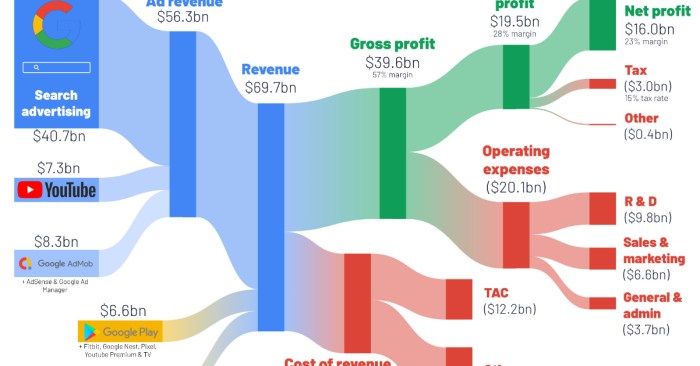
| Google (Alphabet) | 56% | 26% | 21% |
| Intel | 50% | 18% | 15% |
Trends in Technology Sector Profit Margins
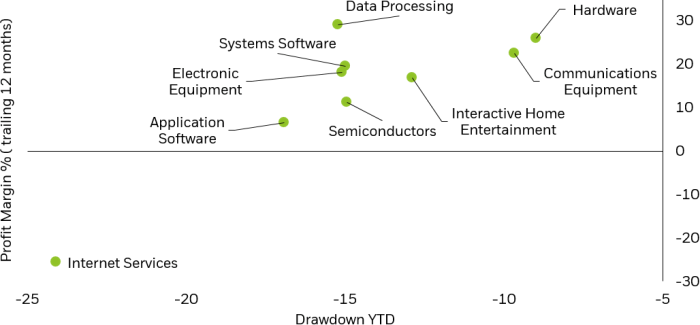
The technology sector’s profit margins have experienced significant fluctuations over the past decade, shaped by a complex interplay of innovation, competition, economic conditions, and evolving consumer preferences. Understanding these trends is crucial for investors, businesses, and policymakers alike. This section will analyze key trends, comparing the performance of major players and examining the impact of economic cycles.
Profit margin trends within the technology sector haven’t followed a single, consistent path. Instead, they’ve been characterized by periods of robust growth punctuated by contractions, often mirroring broader economic cycles but also influenced by sector-specific dynamics like the rapid rise and fall of certain technologies or disruptive innovations. The competitive landscape, with its constant innovation and mergers and acquisitions, further complicates any simple analysis.
Comparison of Profit Margin Performance Among Technology Giants
Several technology giants have exhibited contrasting profit margin trajectories. For example, companies heavily reliant on advertising revenue, like Google (Alphabet) and Meta (Facebook), have seen their margins influenced by shifts in digital advertising spending, particularly during economic downturns. Conversely, companies with strong recurring revenue models, such as subscription-based software providers like Salesforce or Microsoft’s cloud services (Azure), often demonstrate greater margin stability.
Hardware manufacturers, like Apple, tend to exhibit a different pattern again, influenced by supply chain issues, component costs, and consumer demand for new devices. The relative dominance of different business models significantly impacts the profit margin performance of these companies.
Impact of Economic Cycles on Technology Sector Profit Margins
Economic cycles exert a considerable influence on technology sector profit margins. The relationship isn’t always straightforward, however, as technology companies often demonstrate resilience even during economic slowdowns. This resilience is partly due to the essential nature of technology in modern business and daily life.
- Recessions: During economic downturns, businesses often cut discretionary spending, including technology investments. This can lead to reduced demand for certain technology products and services, resulting in lower profit margins for some companies. However, companies offering cost-saving solutions or essential services may experience increased demand and maintain relatively stable margins.
- Expansions: Periods of economic growth typically translate to increased spending on technology, boosting demand and potentially improving profit margins across the sector. However, increased competition during expansionary periods can also squeeze margins if companies engage in price wars to gain market share.
- Specific Examples: The 2008 financial crisis saw a significant drop in technology spending, impacting profit margins across the board. However, the subsequent recovery saw a resurgence in investment, particularly in cloud computing and mobile technologies, leading to substantial growth for companies positioned to capitalize on these trends. The COVID-19 pandemic initially led to uncertainty, but ultimately spurred a surge in demand for remote work and online services, benefiting many tech companies.
This highlights the dynamic nature of the relationship between economic cycles and technology profit margins.
Factors Affecting Technology Sector Profit Margins
Profit margins in the technology sector are a complex interplay of several key factors. Understanding these influences is crucial for both investors assessing potential returns and companies strategizing for long-term success. While innovation drives growth, the path to profitability is paved with challenges related to R&D investment, competitive pressures, and the delicate art of pricing.
Research and Development Spending’s Impact on Profit Margins
High research and development (R&D) expenditure is a defining characteristic of the technology sector. This investment, while essential for innovation and future growth, directly impacts current profit margins. Significant upfront costs associated with developing new products, technologies, and software can significantly reduce short-term profitability. However, successful R&D leads to the creation of innovative products and services with high profit potential in the long term, potentially offsetting initial losses.
Companies like Google and Amazon, known for their substantial R&D budgets, exemplify this long-term strategy. Their continuous innovation in areas like AI and cloud computing ultimately translates into substantial revenue streams and higher profit margins over time, even though short-term margins might be compressed due to the high R&D investment. The balance between short-term profitability and long-term innovation is a constant strategic consideration for technology companies.
Competition and Market Saturation’s Influence on Profit Margins
The technology sector is fiercely competitive. High barriers to entry exist in some areas (e.g., semiconductor manufacturing), but the rapid pace of innovation and the ease of entry in others (e.g., software development) create a dynamic and often cutthroat environment. As markets become saturated with similar products or services, pricing pressures intensify, squeezing profit margins. The smartphone market, for instance, illustrates this point.
The initial high margins enjoyed by early entrants have significantly diminished due to increased competition and market saturation. This necessitates constant innovation and differentiation to maintain a competitive edge and protect profit margins. Companies must focus on creating unique value propositions and strengthening brand loyalty to avoid becoming a commodity player.
Pricing Strategies and Their Effect on Profit Margins
Pricing strategies play a pivotal role in determining technology sector profit margins. Different models offer varying degrees of control over profitability and market share.
| Pricing Model | Description | Effect on Profit Margin | Example |
|---|---|---|---|
| Premium Pricing | Charging a high price based on perceived value and superior features. | High profit margin, but potential for lower sales volume. | High-end smartphones (e.g., iPhone Pro Max) |
| Value Pricing | Offering competitive pricing based on perceived value relative to competitors. | Moderate profit margin, but potential for higher sales volume. | Mid-range smartphones (e.g., Google Pixel A series) |
| Penetration Pricing | Setting a low initial price to gain market share rapidly. | Low profit margin initially, but potential for higher volume and future margin increases. | New streaming services during launch phase. |
| Freemium Pricing | Offering a basic service for free and charging for premium features. | Variable profit margin depending on conversion rates from free to paid users. | Many mobile apps and software platforms. |
Profit Margins and Innovation
Innovation is the lifeblood of the technology sector, directly impacting profit margins. A company’s ability to consistently develop and launch successful new products or services is often the key differentiator between high-margin players and those struggling to stay afloat. This relationship, however, is complex and not always linear; while innovation can drive significant margin expansion, it also involves considerable upfront investment with no guarantee of success.The link between innovation and profit margins is multifaceted.
Successful innovation leads to higher prices due to unique features and functionality, reduced production costs through efficiency improvements, and increased market share through competitive advantage. Conversely, failed innovations can lead to substantial losses, eroding profit margins and potentially impacting the company’s long-term viability. This inherent risk-reward dynamic is a core characteristic of the technology industry.
Successful Technological Innovations and Profit Margin Impact
The impact of successful technological innovations on profit margins is readily apparent across numerous examples. Apple’s introduction of the iPhone, for instance, revolutionized the mobile phone market, resulting in significantly higher profit margins compared to its competitors due to its premium pricing and strong brand loyalty. Similarly, the development and adoption of cloud computing services by companies like Amazon Web Services (AWS) have generated substantial profits due to high recurring revenue streams and economies of scale.
The success of these innovations stemmed not only from technological advancements but also from effective marketing, strong ecosystems, and efficient operational models that all contributed to improved profit margins.
Hypothetical Scenario: Impact of AI-Powered Drug Discovery on Pharmaceutical Profit Margins
Imagine a hypothetical scenario where a new biotechnology company develops an AI-powered platform capable of significantly accelerating and improving the drug discovery process. This technology reduces the time and cost associated with bringing new pharmaceuticals to market, thereby increasing efficiency. Currently, the pharmaceutical industry faces high research and development (R&D) costs, which often lead to relatively low profit margins on individual drugs.
This new AI platform could drastically reduce R&D expenditure, allowing the company to bring more drugs to market faster and at lower cost. Consequently, the company could achieve higher profit margins on each drug, while also increasing overall revenue due to a more robust drug pipeline. This scenario is analogous to what is already happening with the application of AI in various industries, where the potential for enhanced efficiency translates directly into improved profitability.
The reduced time-to-market also provides a significant competitive advantage, allowing the company to capture market share and further bolster its profit margins. While this is a hypothetical example, it reflects the real-world potential for innovative technologies to reshape industry dynamics and dramatically impact profit margins.
Profit Margins and the Global Economy
The technology sector, while often perceived as operating in a globalized and borderless digital realm, is significantly impacted by the ebbs and flows of the global economy. Fluctuations in currency exchange rates, trade disputes, and geopolitical instability all directly influence the profitability of technology companies, often in complex and unpredictable ways. These external factors can significantly affect revenue streams, operational costs, and ultimately, profit margins.Global economic factors such as exchange rates and trade wars exert considerable pressure on technology sector profit margins.
For instance, a strengthening US dollar makes US-based technology exports more expensive in other markets, potentially reducing demand and revenue. Conversely, a weakening dollar can boost export sales but may also increase the cost of imported components, impacting profitability. Trade wars, characterized by tariffs and trade restrictions, directly affect the cost of goods and services, impacting both input costs and market access for technology companies.
These impacts vary depending on the company’s supply chains and geographic market concentration.
Exchange Rate Fluctuations and Technology Profitability
Exchange rate volatility creates uncertainty for technology companies with significant international operations. Consider a hypothetical scenario where a major European technology firm, reliant on US dollar-denominated components, sees the Euro depreciate sharply against the dollar. The increased cost of importing these components directly eats into their profit margin, potentially necessitating price increases or operational efficiency improvements to maintain profitability.
Conversely, a strong Euro would allow them to offer more competitive prices in the US market, potentially boosting sales and market share. The impact, therefore, is heavily dependent on the specific currency pairings, the company’s sourcing strategy, and its pricing policies.
Geopolitical Events and Their Impact
Geopolitical events, such as international conflicts, political instability, and sanctions, introduce significant risks to technology companies’ profit margins. These events can disrupt supply chains, limit market access, and create uncertainty for investors. For example, escalating tensions in a region crucial for semiconductor manufacturing could lead to shortages, driving up component costs and squeezing profit margins for companies reliant on these components.
Similarly, sanctions imposed on a particular country could severely restrict a technology company’s ability to operate within that market, resulting in lost revenue and reduced profitability.
Impact of a Major Global Event on a Technology Company
Let’s consider a hypothetical scenario involving a major global pandemic similar to the COVID-19 outbreak. Imagine a company like Zoom, a video conferencing platform. Initially, the pandemic led to a surge in demand as businesses and individuals shifted to remote work and communication. This resulted in a significant increase in Zoom’s revenue and profit margins. However, as the pandemic progressed and lockdowns eased, the demand for video conferencing services normalized, leading to a decrease in growth rates and potentially impacting their profit margins.
Furthermore, increased competition emerged as other companies invested in and improved their own video conferencing capabilities. The initial boom was followed by a period of adjustment, highlighting the complex relationship between global events and the profitability of even the most successful technology companies. Supply chain disruptions for hardware components could have also negatively impacted the availability of their products, further influencing their profitability.
The company’s ability to adapt its strategies to the changing environment and navigate the new competitive landscape directly impacted its long-term profit margins.
Ultimately, understanding technology sector profit margins requires a holistic view, encompassing financial analysis, market dynamics, and technological advancements. While predicting the future remains inherently challenging, careful consideration of the factors discussed here – including R&D investment, competition, pricing strategies, and global economic influences – provides a framework for informed analysis and strategic planning. The technology sector’s profitability is a dynamic reflection of its innovative spirit and resilience in the face of continuous change.
FAQs
What are the limitations of using profit margins as a sole indicator of a tech company’s health?
Profit margins offer a valuable snapshot, but shouldn’t be the only metric considered. Factors like revenue growth, debt levels, and market share provide a more complete picture. A high profit margin might mask underlying weaknesses.
How do accounting practices affect reported profit margins?
Different accounting methods (e.g., revenue recognition, depreciation) can impact reported profit margins. Comparing companies requires understanding their accounting practices to ensure a fair comparison.
How do startups typically approach profit margins in their early stages?
Startups often prioritize market share and growth over immediate profitability. They may accept lower profit margins initially to gain traction and scale their operations.


