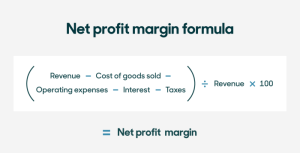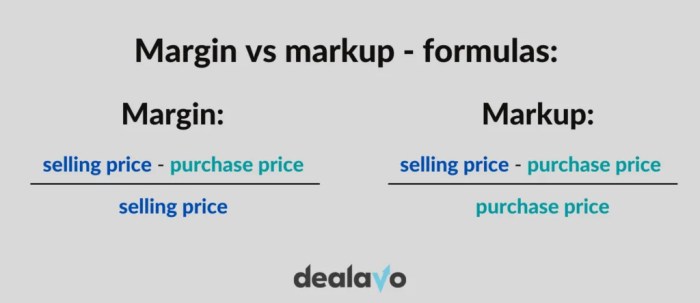
Understanding the difference between profit margin and markup is crucial for any business aiming for sustainable profitability. While often used interchangeably, these metrics offer distinct perspectives on pricing and profitability. Profit margin reveals the percentage of revenue remaining after deducting all costs, providing a clear picture of overall financial health. Markup, on the other hand, focuses on the percentage added to the cost of goods to determine the selling price.
Mastering both is key to setting competitive prices while ensuring healthy returns.
This analysis will explore the calculation, relationship, and impact of both profit margin and markup on business success. We’ll delve into various pricing strategies and examine how factors like cost of goods sold, operating expenses, and sales volume influence these key performance indicators. Through real-world examples and insightful comparisons, we aim to equip you with a comprehensive understanding of how to leverage these metrics for optimal financial performance.
Defining Profit Margin and Markup
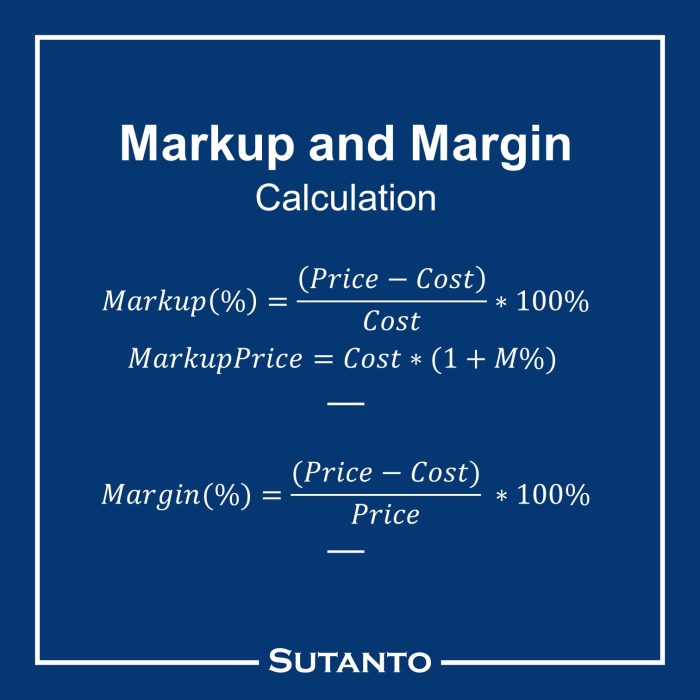
Understanding the difference between profit margin and markup is crucial for any business owner aiming to maximize profitability. While both relate to profit, they represent different perspectives on how that profit is calculated and interpreted. Essentially, markup focuses on the cost of goods, while profit margin looks at the selling price.Profit margin and markup are two key financial metrics that businesses use to assess their profitability.
A simple analogy to illustrate the difference is thinking about buying and selling lemonade. Your markup is how much extra you charge above the cost of making the lemonade (lemons, sugar, water, cups). Your profit margin, on the other hand, is the percentage of your selling price that represents profit after deducting all your costs (including the cost of lemons, sugar, water, cups, and any other expenses like rent or labor).
Examples of Businesses with Varying Profit Margins and Markups
High-profit margin businesses often involve products or services with high perceived value and lower production costs. For example, software companies can have extremely high profit margins because the cost of producing an additional copy of software is minimal. However, their markup might not seem excessively high compared to the price of the software. Conversely, grocery stores typically operate on very low profit margins, often less than 1%, meaning their markup is also low.
This is because they have high operating costs and face intense competition. They sell a large volume of products to compensate for the small profit on each item.
Profit Margin and Markup Calculation Methods
The following table illustrates the calculation methods for both profit margin and markup. Understanding these calculations allows businesses to strategically price their products and services to achieve their desired profit goals.
| Product | Cost | Markup Percentage | Selling Price | Profit Margin Percentage |
|---|---|---|---|---|
| Designer Handbag | $50 | 100% | $100 | 50% |
| Grocery Item (e.g., Milk) | $3 | 5% | $3.15 | 5% |
| Software License | $10 | 500% | $60 | 83.33% |
Profit Margin = (Selling Price – Cost) / Selling Price – 100%
Markup = (Selling Price – Cost) / Cost – 100%
Calculating Profit Margin and Markup
Understanding how to calculate profit margin and markup is crucial for effective pricing strategies and ensuring business profitability. These calculations allow businesses to determine the selling price of their products or services, considering both costs and desired profit levels. Accurate calculations are essential for financial planning and informed decision-making.
Profit Margin Calculation
Profit margin represents the percentage of revenue that remains after deducting all expenses. It’s a key indicator of a business’s profitability and efficiency. The calculation is straightforward and provides valuable insights into the financial health of a company. A higher profit margin generally indicates better financial performance.
Profit Margin = (Revenue – Cost of Goods Sold) / Revenue – 100%
For example, if a company sells a product for $100 and the cost of goods sold is $60, the profit margin is calculated as follows: (100 – 60) / 100100% = 40%. This means the company retains 40% of its revenue as profit after covering its costs.
Markup Calculation
Markup, on the other hand, represents the percentage increase added to the cost of a product or service to arrive at the selling price. It directly reflects the desired profit level relative to the cost of production or acquisition. A higher markup percentage generally leads to a higher profit per unit sold, but it can also impact price competitiveness.
Markup = (Selling Price – Cost) / Cost – 100%
Let’s say the cost of a product is $50, and the desired profit margin is 25%. To determine the markup, we first calculate the desired profit: $50
- 0.25 = $12.
- The selling price would then be $50 + $12.50 = $62.
- 100% = 25%.
50. The markup is calculated as
($62.50 – $50) / $50
Determining Selling Price Based on Desired Markup
Determining the appropriate selling price is a crucial step in business operations. This process involves carefully considering the cost of goods, desired profit margins, and market competitiveness. A step-by-step guide facilitates this process and helps in setting a price that maximizes profitability while remaining attractive to customers.
- Determine the cost of goods sold (COGS): This includes all direct costs associated with producing or acquiring the product or service.
- Determine the desired markup percentage: This percentage reflects the desired profit level. The choice of markup will depend on various factors, including market analysis, competitor pricing, and business objectives.
- Calculate the markup amount: Multiply the COGS by the desired markup percentage (expressed as a decimal). For example, a 30% markup on a $20 COGS would be $20 – 0.30 = $6.
- Calculate the selling price: Add the markup amount to the COGS. In our example, the selling price would be $20 + $6 = $26.
Following these steps ensures that the selling price accurately reflects the desired profit margin and covers all associated costs. Careful consideration of market dynamics and competitor pricing is crucial for optimal pricing strategies.
The Relationship Between Profit Margin and Markup
Profit margin and markup, while distinct concepts, are intrinsically linked, reflecting different perspectives on profitability. Understanding their relationship is crucial for effective pricing and business strategy. A change in one directly impacts the other, and their interplay is heavily influenced by factors such as costs and pricing strategies.
Impact of Cost Changes on Profit Margin and Markup
Changes in the cost of goods sold (COGS) significantly affect both profit margin and markup. An increase in COGS, holding the selling price constant, directly reduces the profit margin. Conversely, a decrease in COGS increases the profit margin. The impact on markup is less direct. While a higher COGS necessitates a higher markup to maintain the desired profit margin, the actual markup percentage may need adjustment depending on market conditions and competitive pricing.
For instance, if a company experiences a sudden rise in raw material costs, it might choose to absorb some of the increase to maintain competitiveness, resulting in a smaller markup increase than the COGS increase would suggest. Conversely, if a company discovers a more efficient production process, lowering COGS, it might choose to lower prices to gain market share, leading to a smaller reduction in markup than the COGS reduction might otherwise imply.
Influence of Different Pricing Strategies
Different pricing strategies directly influence the relationship between profit margin and markup. Cost-plus pricing, a straightforward approach where a fixed percentage markup is added to the COGS, creates a direct link between the two. A higher markup directly translates to a higher profit margin (assuming sales volume remains constant). However, this method doesn’t account for market demand or competitor pricing, potentially leading to an uncompetitive price point and lower sales.
Value-based pricing, on the other hand, prioritizes customer perception of value. The price is set based on the perceived value of the product or service, and the resulting profit margin determines the effective markup. In value-based pricing, the markup is a consequence of the price, not its determinant. This strategy can lead to higher profit margins if the perceived value justifies a higher price, but it requires a thorough understanding of customer needs and preferences.
Scenario: Markup Change and its Effect on Profit Margin
Let’s consider a scenario involving a small bakery selling cupcakes. Their current COGS per cupcake is $2, and they use a 50% markup, resulting in a selling price of $3. Their profit margin is 33.33% (($3-$2)/$3).Now, let’s assume they increase their markup to 75%, resulting in a selling price of $3.50. Their profit margin increases to 42.86% (($3.50-$2)/$3.50).
This demonstrates a direct relationship between markup and profit margin at a constant COGS.However, consider the impact of sales volume. If the higher price ($3.50) reduces sales volume by 20%, the total profit might actually decrease despite the higher profit margin per cupcake. Suppose they initially sold 100 cupcakes, generating a profit of $100. With the higher markup and reduced sales (80 cupcakes), the profit becomes $120 (80 cupcakes$1.50 profit per cupcake).
In this instance, the higher markup still yields a higher total profit, even with reduced sales. But if the sales volume decrease was more significant (e.g., 40% or more), the total profit could potentially be lower despite the higher profit margin per unit. This highlights the importance of considering the elasticity of demand when adjusting markup.
Ultimately, the effective management of profit margin and markup requires a holistic understanding of your business model, cost structure, and market dynamics. While markup provides a straightforward approach to pricing, profit margin offers a more comprehensive assessment of your financial success. By skillfully balancing both, businesses can optimize pricing strategies, enhance profitability, and achieve sustainable growth. Regularly monitoring and analyzing these key metrics is essential for informed decision-making and achieving long-term financial stability.
Frequently Asked Questions
What is the difference between gross profit margin and net profit margin?
Gross profit margin considers only the cost of goods sold, while net profit margin accounts for all expenses, including operating costs, taxes, and interest.
Can a business have a high markup but a low profit margin?
Yes, this can occur if the business has high operating expenses or low sales volume, despite having a high markup on individual products.
How does competition affect markup and profit margin?
High competition often necessitates lower markups to remain competitive, potentially impacting profit margins unless efficiency improvements offset reduced pricing.
What is a healthy profit margin?
A “healthy” profit margin varies significantly across industries. Research industry benchmarks to determine a reasonable target for your specific sector.